2020 Ford Explorer Towing and Payload Capacity
- Max towing5,600 lbsST AWD
- Best towing setup3.0L V6 turbo, AWD
- Towing range5,000–5,600 lbs10 trims
- Hitch for max towClass 32-inch receiver
The 2020 Ford Explorer can tow 5,000 to 5,600 lbs when properly equipped. The top rating belongs to the ST AWD with the 3.0L V6 turbo. Use the door-jamb label and owner's manual for payload limits. The lineup offers 3 engines across 10 trims.
Towing Capacity by Engine
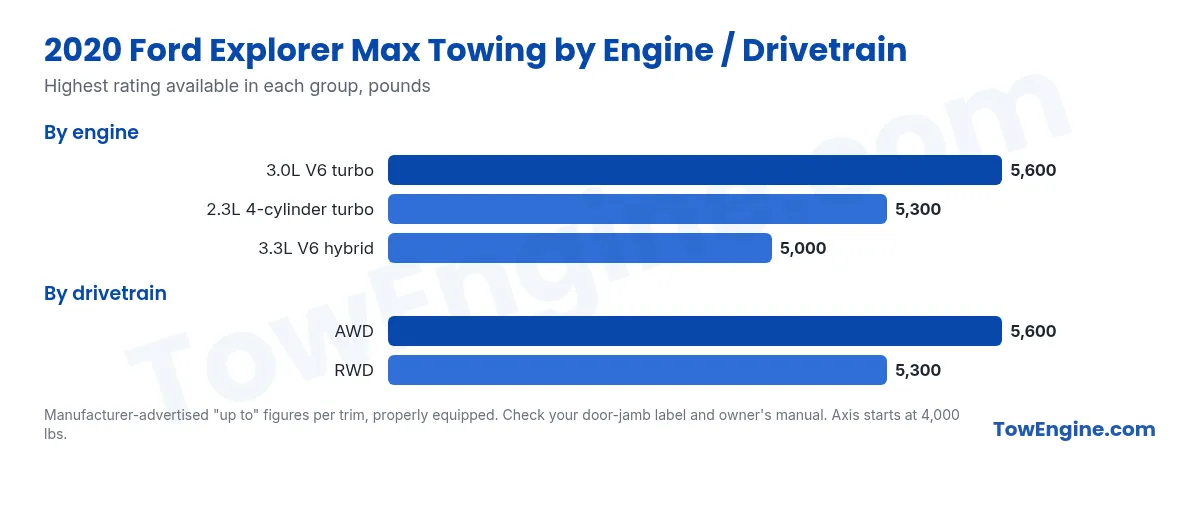
The 3.0L V6 turbo is the strongest towing engine in the Ford Explorer lineup at up to 5,600 lbs on the ST AWD. Related powertrains with published ratings: the 2.3L 4-cylinder turbo and 3.3L V6 hybrid.
| Engine | Power | Transmission | Max towing capacity | Max payload capacity | Where you get it |
|---|---|---|---|---|---|
| 3.0L V6 turbo | 400 hp @ 5,500, 415 lb-ft @ 3,500 | 10-speed shiftable automatic | 5,600 lbs | Not listed† | Standard on ST AWD and Platinum AWD |
| 2.3L 4-cylinder turbo | 300 hp @ 5,500, 310 lb-ft @ 3,500 | 10-speed shiftable automatic | 5,300 lbs | Not listed† | Standard on 4dr SUV, 4dr SUV AWD, XLT and others |
| 3.3L V6 hybrid | 318 hp @ 6,500, 322 lb-ft @ 3,000 | 10-speed shiftable automatic | 5,000 lbs | Not listed† | Standard on Limited Hybrid and Limited Hybrid AWD |
† Not listed means no figure is published for that engine here — not that it cannot tow. Check Ford's official towing guide for the 2020 model or the owner's manual for the rating.
3.0L V6 turbo
Its best setup is the ST AWD at 5,600 lbs, enough for pop-up campers. It is standard equipment on the ST AWD and Platinum AWD.
2.3L 4-cylinder turbo
Rated up to 5,300 lbs, it is best on the 4dr SUV RWD, enough for teardrop trailers. It comes standard on 4dr SUV, 4dr SUV AWD and related trims.
3.3L V6 hybrid
On the Limited Hybrid RWD it reaches 5,000 lbs, enough for small travel trailers. Factory fitment covers the Limited Hybrid and Limited Hybrid AWD.
How the Drivetrain Changes Towing
Choose AWD on the 2020 Ford Explorer to reach the 5,600 lbs maximum towing capacity. The same model with RWD is rated 5,300 lbs, 300 lbs less, usually because the strongest engine or axle ratio comes with AWD.
| Version | AWD max towing capacity | RWD max towing capacity |
|---|---|---|
| All versions | 5,600 lbs | 5,300 lbs |
Each cell shows the top tow rating for that combination, with the highest payload beneath it.
Every Trim Compared
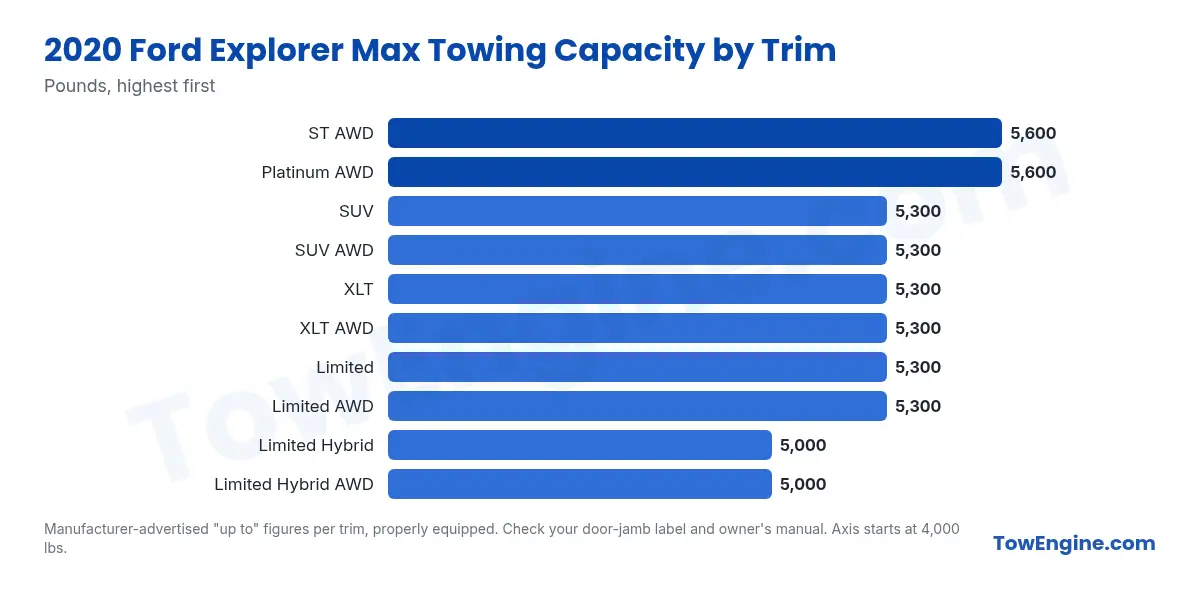
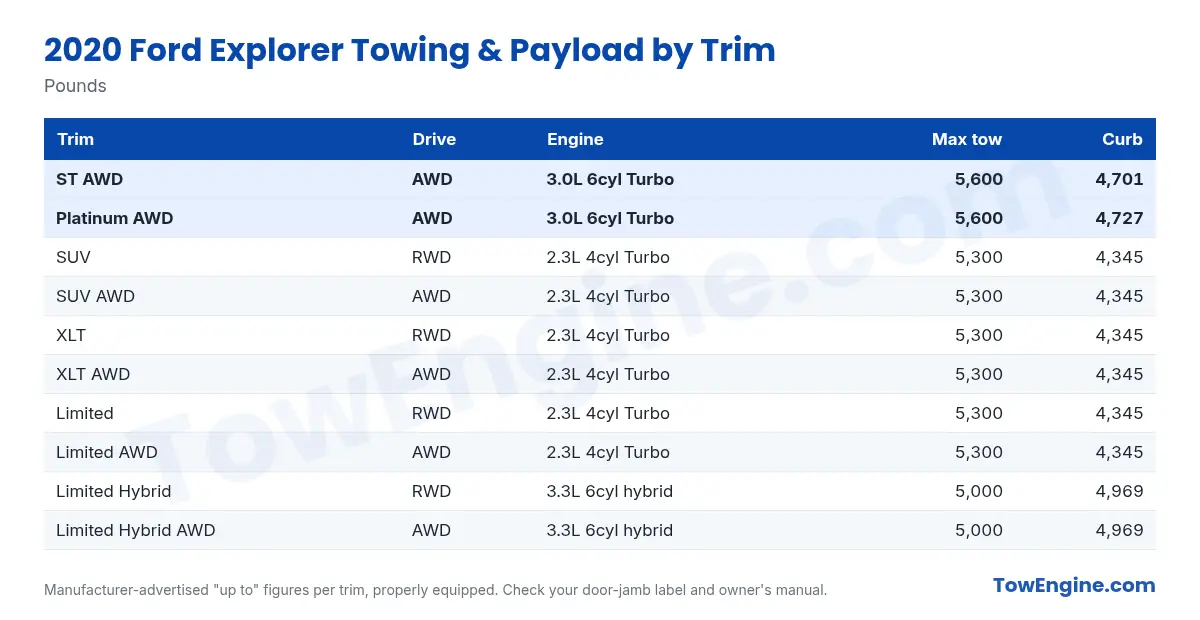
Across the 10 rated trims, ratings run from 5,000 lbs on the Limited Hybrid RWD to 5,600 lbs on the ST AWD. Use the filters to narrow the list by engine, drivetrain or cab.
| Trim | Drive | Engine | Power | Max towing capacity | Curb weight |
|---|---|---|---|---|---|
| ST AWD | AWD | 3.0L V6 turbo | 400 hp | 5,600 | 4,701 |
| Platinum AWD | AWD | 3.0L V6 turbo | 365 hp | 5,600 | 4,727 |
| 4dr SUV | RWD | 2.3L 4-cylinder turbo | 300 hp | 5,300 | 4,345 |
| 4dr SUV AWD | AWD | 2.3L 4-cylinder turbo | 300 hp | 5,300 | 4,345 |
| XLT | RWD | 2.3L 4-cylinder turbo | 300 hp | 5,300 | 4,345 |
| XLT AWD | AWD | 2.3L 4-cylinder turbo | 300 hp | 5,300 | 4,345 |
| Limited | RWD | 2.3L 4-cylinder turbo | 300 hp | 5,300 | 4,345 |
| Limited AWD | AWD | 2.3L 4-cylinder turbo | 300 hp | 5,300 | 4,345 |
| Limited Hybrid | RWD | 3.3L V6 hybrid | 318 hp | 5,000 | 4,969 |
| Limited Hybrid AWD | AWD | 3.3L V6 hybrid | 318 hp | 5,000 | 4,969 |
All weights in lbs. Each row is the trim's best published rating; "—" means no published figure.
Towing Options Worth Ordering
For higher tow ratings, buyers usually need a factory tow package. The Class III Trailer Tow Package shows up most often (6 trims).
| Option or package | Available on |
|---|---|
| Class III Trailer Tow Package | XLT, XLT AWD, Limited, Limited AWD, Limited Hybrid and 1 more |
Wheelbase, Fuel and Other Towing Specs
Wheelbase runs 119.1 in, the tank holds 17.9–20.2 gallons and EPA highway economy is 24–29 mpg (expect far less with a trailer).
A longer wheelbase is steadier with a trailer behind it; at 119 in, this one sits in the middle of the range. Towing often halves fuel economy, so the 20.2-gallon tank means more frequent stops.
| Spec | Range across trims |
|---|---|
| Wheelbase | 119.1 in |
| Overall length | 198.8–199.3 in |
| Fuel tank | 17.9–20.2 gal |
| EPA city | 18–27 mpg |
| EPA highway | 24–29 mpg |
| Seating | 6–7 seats |
| Ground clearance | 7.9–8.3 in |
| Overall height | 69.9–70.2 in |
| Body width (no mirrors) | 78.9 in |
| Width with mirrors | 89.3 in |
Off-Road Angles and Clearance
Approach angle 21°, departure angle 21–22.3° and breakover angle 17.1–17.7°. Departure angle drops once a receiver and ball mount hang off the back, which matters on boat ramps and steep driveways.
| Angle / depth | Range across trims |
|---|---|
| Approach angle | 21° |
| Departure angle | 21–22.3° |
| Breakover angle | 17.1–17.7° |
Engine and Chassis Specifications
Engine Specifications
The 3.0L V6 turbo is twin-turbocharged, with direct injection, a compression ratio of 9.5:1 and 85.4 × 86.0 mm bore and stroke. It holds about 6.0 quarts of oil (5W-30 grade). The table lines up the same figures for both engines. If you tow often, follow the severe-service maintenance schedule rather than the normal one.
| Spec | 3.0L V6 turbo | 2.3L 4-cylinder turbo |
|---|---|---|
| Layout | V6, twin-turbo | Inline-4, turbocharged, intercooled |
| Displacement | 2,956 cc | 2,261 cc |
| Bore × stroke | 85.4 × 86.0 mm | 87.5 × 94.0 mm |
| Compression ratio | 9.5:1 | 10:1 |
| Fuel system | Direct injection | Direct injection |
| Valvetrain | DOHC | DOHC |
| Engine oil capacity | 6.0 qt | 5.2 qt |
| Oil viscosity | 5W-30 | 5W-30 |
| Coolant capacity | 18.0 qt | 14.1 qt |
Chassis, Suspension, Brakes and Tires
Up front it uses macPherson struts, coil springs, anti-roll bar; the rear has multi-link, anti-roll bar. Brakes are discs in front and discs at the rear. Factory tire sizes run from 255/65R18 to 275/45R21. Tire pressure matters more with a trailer; use the full-load figures from the door placard.
| Component | Details |
|---|---|
| Front suspension | MacPherson struts, coil springs, anti-roll bar |
| Rear suspension | Multi-link, anti-roll bar |
| Front brakes | Discs |
| Rear brakes | Discs |
| Steering | Rack and pinion |
| Factory tire sizes | 255/65R18, 255/55R20, 275/45R21 |
Choosing the Right Hitch
Match hitch class to the load: the 2020 Ford Explorer uses a Class 3 with a 2-inch receiver for its 5,600-lb rating.
| Hitch class | Receiver | Max trailer weight | Max tongue weight |
|---|---|---|---|
| Class 2 | 1-1/4-inch | 3,500 lbs | 350 lbs |
| Class 3 | 2-inch | 8,000 lbs | 800 lbs |
| Class 4 | 2-inch | 10,000 lbs | 1,000 lbs |
| Class 5 Xtra Duty | 2-inch | 17,000 lbs | 2,550 lbs |
| Class 5 Commercial Duty | 2-1/2-inch | 20,000 lbs | 2,700 lbs |
Tongue weight for a 5,600-lb trailer should land around 560–840 lbs (10–15%), and every pound of it is payload.
Above about 5,000 lbs, or when the tongue weight exceeds half of the hitch's rating, a weight-distribution hitch and a trailer brake controller are strongly recommended.
Compare Class 3 hitches & ball mounts
Can It Tow Your Trailer?
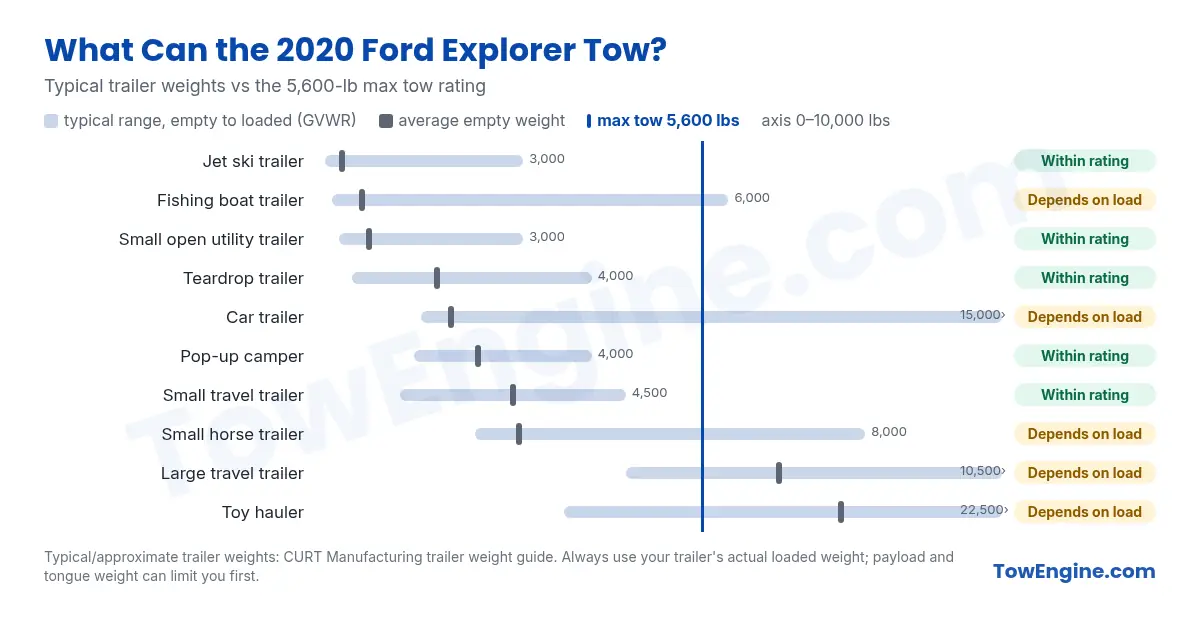
Its 5,600-lb rating covers trailers as heavy as small travel trailers and teardrop trailers. Fishing boat trailers, car trailers, small horse trailers and 2 more depend on the actual loaded weight.
| Trailer | Typical loaded weight | Vs max towing capacity |
|---|---|---|
| Jet ski trailer | 800–3,000 lbs | Within rating |
| Fishing boat trailer | 900–6,000 lbs | Depends on the trailer |
| Small open utility trailer | 1,000–3,000 lbs | Within rating |
| Teardrop trailer | 2,000–4,000 lbs | Within rating |
| Car trailer | 6,000–15,000 lbs | Depends on the trailer |
| Pop-up camper | 2,700–4,000 lbs | Within rating |
| Small travel trailer | 1,900–4,500 lbs | Within rating |
| Small horse trailer | 7,000–8,000 lbs | Depends on the trailer |
| Large travel trailer | 6,300–10,500 lbs | Depends on the trailer |
| Toy hauler | 14,700–22,500 lbs | Depends on the trailer |
Typical loaded weights only. Your own trailer, plus what you load in the vehicle (up to published of payload), decides what is realistic.
Brake controllers, locks & more for up to 5,600 lbs
What Changed Since 2019
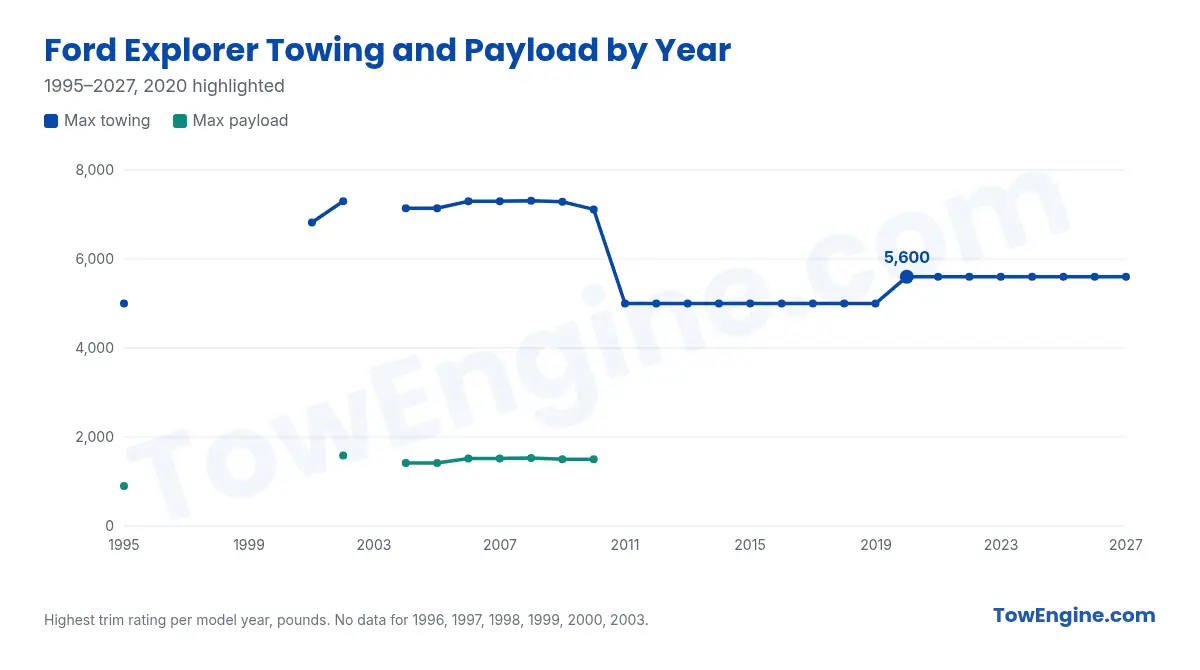
Maximum towing rose 600 lbs (12.0%) from the 2019 model's 5,000 lbs to 5,600 lbs. New this year: the 3.0L V6 turbo and 3.3L V6 hybrid. No longer offered: the 3.5L V6 and 3.5L V6 turbo. See the 2019 Ford Explorer ratings.
Towing Capacity by Model Year
How neighbouring model years compare (full 1995–2027 history in the chart below):
Other Ford Explorer model years: 2011, 2012, 2013, 2014, 2015, 2016 (+ 4 more in the table).
| Model year | Max towing capacity | Max payload capacity |
|---|---|---|
| 2016, 2017, 2018, 2019 | 5,000 lbs | — |
| 2020 | 5,600 lbs | — |
| 2021, 2022, 2023, 2024 | 5,600 lbs | — |
Towing and Payload Charts

Recommended Towing Gear for the Explorer
As an Amazon Associate I earn from qualifying purchases.
For a 5,600-lb trailer, the gear that matters most is a locking hitch pin, a brake controller, a weight-distribution hitch and hitch and coupler locks.
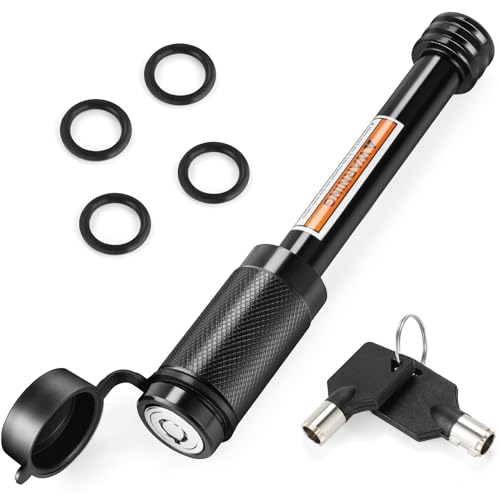
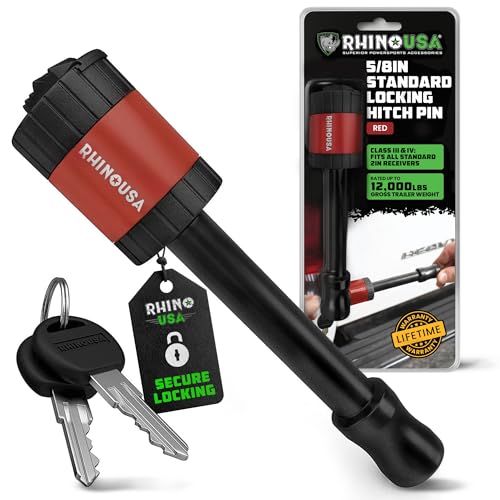
Locking Hitch Pin for the Factory Receiver
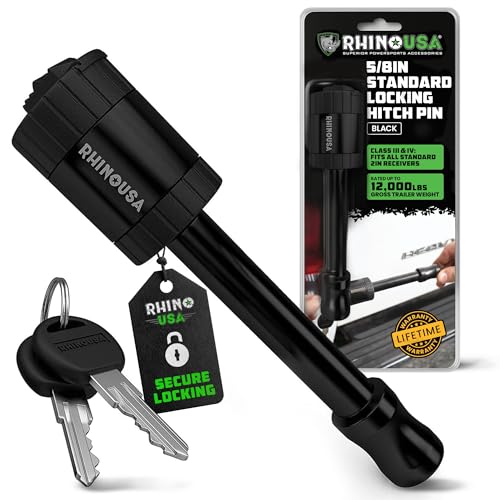
With the factory receiver fitted, add a 2 inch locking pin so the ball mount stays put when you park.
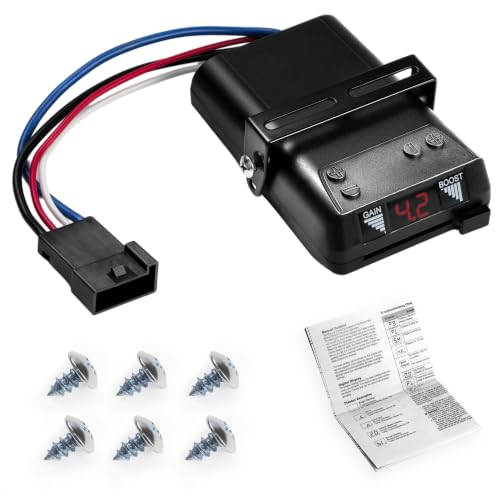
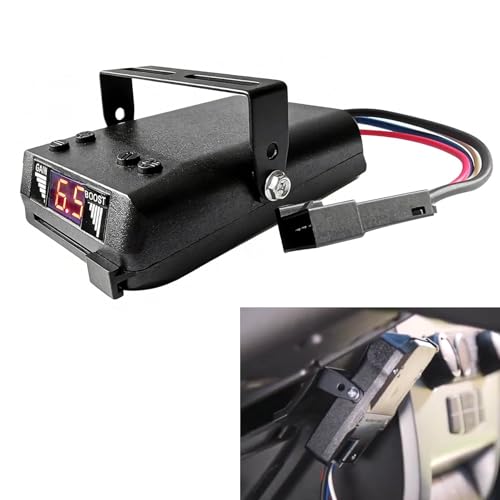
Trailer Brake Controller
Skip it only if your trim has an integrated controller; otherwise a proportional unit is the first thing to add for trailers up to 5,600 lbs.

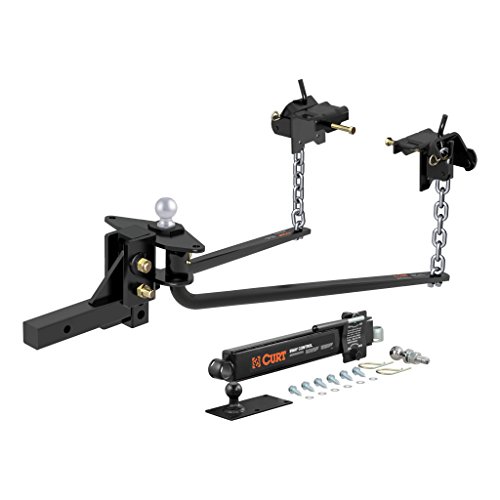
Weight-Distribution Hitch With Sway Control
Many owner's manuals call for weight distribution above about 5,000 lbs; size the spring bars for a 840-lb tongue weight.


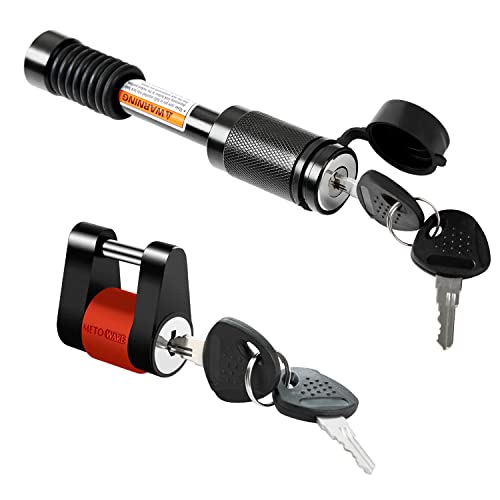
Hitch and Coupler Locks
A parked trailer is easy to drive off with; a coupler lock and a pin lock close that gap.


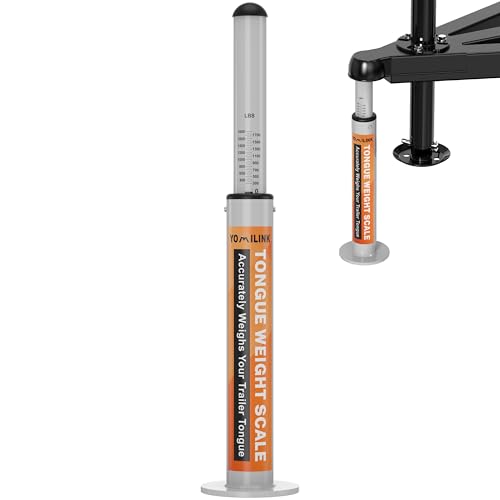
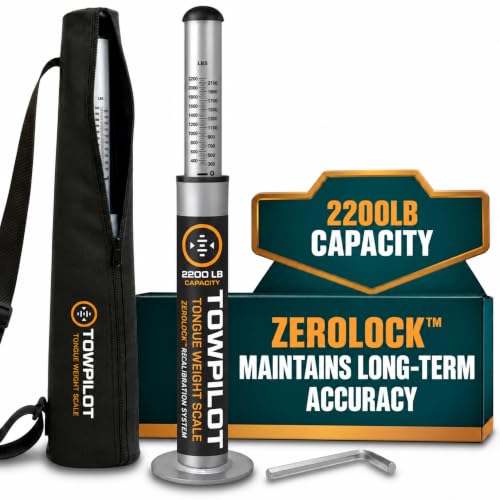
Tongue Weight Scale
For a 5,600-lb trailer, aim for 560–840 lbs on the ball; a scale shows where you are.

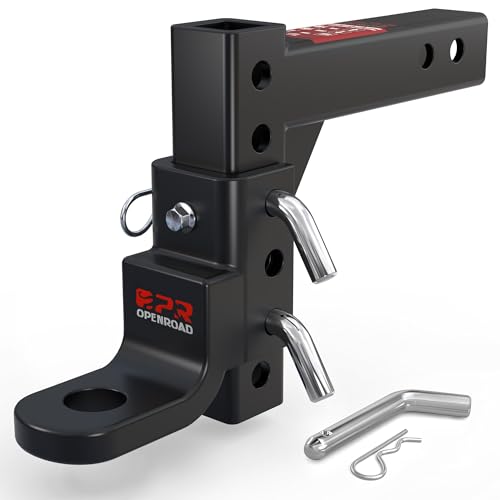
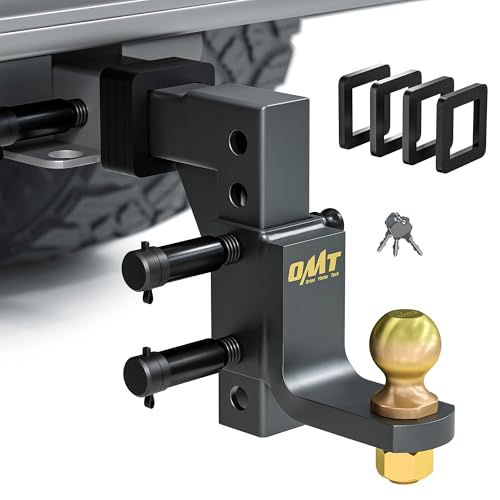
Adjustable Ball Mount
An adjustable 2 inch ball mount lets one truck level different trailers up to 5,600 lbs.

7-Pin to 4-Pin Adapter
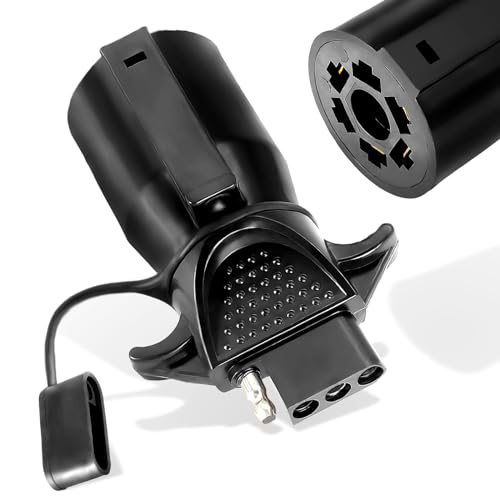
A 7-to-4-pin adapter lets the factory 7-pin socket run the lights on a small 4-pin trailer.


Frequently Asked Questions
How much can the 2020 Ford Explorer tow?
Maximum is 5,600 lbs with the 3.0L V6 turbo on the ST AWD. Ratings start at 5,000 lbs, so check your trim.
Which 2020 Ford Explorer engine is best for towing?
The 3.0L V6 turbo, rated up to 5,600 lbs. Other options: the 2.3L 4-cylinder turbo (up to 5,300 lbs) and the 3.3L V6 hybrid (up to 5,000 lbs).
What size hitch does the 2020 Ford Explorer need?
Use a Class 3 hitch (2-inch opening, roughly 8,000 lbs GTW) for the 5,600 lbs cap. Figure tongue load near 560–840 lbs against payload.
Does the 2020 Ford Explorer need a tow package?
Usually yes for the higher ratings. Best-case figures assume the right package and axle ratio.
Can a 2020 Ford Explorer tow a 5,000-pound trailer?
Yes. Configurations rated up to 5,600 lbs with the 3.0L V6 turbo on the ST AWD clear a 5,000-lb trailer with about 600 lbs of margin when properly equipped.
How do I know if my Ford Explorer has a tow package?
Check the window sticker or VIN build sheet for a trailer-tow or max-tow package name. On the vehicle, look for a factory hitch receiver and a 7-pin trailer connector.
What engines does the 2020 Ford Explorer have?
The 2020 Ford Explorer engines in our data are: 3.0L V6 turbo, 2.3L 4-cylinder turbo and 3.3L V6 hybrid.
Where These Numbers Come From
Towing, payload, GVWR and curb weight figures are manufacturer-advertised "up to" maximums for each trim when properly equipped. A trim's figure is its best case across the engines, axle ratios and tow packages offered on it. Confirm your own vehicle's limits on the door-jamb label and in the owner's manual for your VIN.
- SAE J2807 tow-rating standard
- NHTSA vPIC VIN decoder
- 49 CFR Part 575 (consumer information)
- Hitch classes and typical trailer weights: industry receiver-hitch class charts and typical trailer-weight ranges (approximate).
Data version 2026-10; page updated November 2026.
Explore Capacities by Vehicle Make