2010 Honda Pilot Towing and Payload Capacity
- Max towing4,500 lbsEX-L 4WD
- Best towing setup3.5L V6, 4WD
- Towing range3,500–4,500 lbs12 trims
- Hitch for max towClass 32-inch receiver
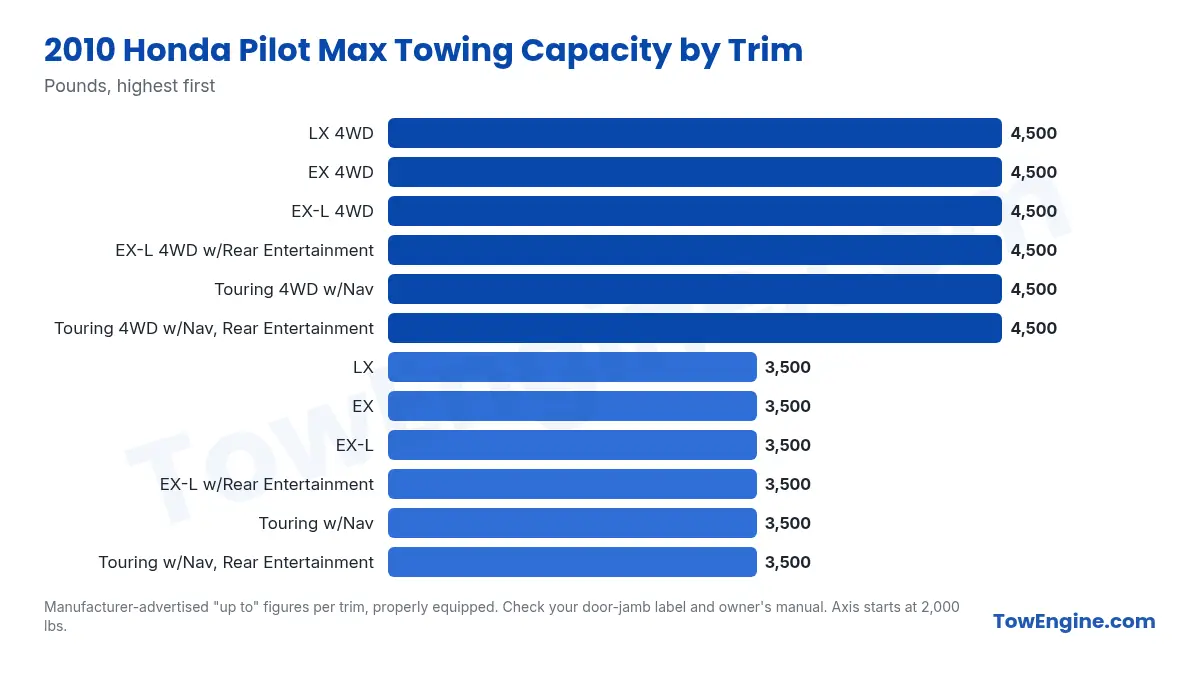
Towing capacity for the 2010 Honda Pilot runs from 3,500 to 4,500 lbs when properly equipped. You reach the maximum with the 3.5L V6 on the EX-L 4WD. Confirm payload on the door-jamb certification label; it is not listed in these rows. Ratings cover 12 trims.
Towing and Payload Capacity
Up to 4,500 lbs is the top tow rating for the Honda Pilot when properly equipped, set by the EX-L 4WD, with 3,500–4,500 lbs across rated trims. Every version uses the 3.5L V6 (250 hp @ 5,700, 253 lb-ft @ 4,800) with a 5-speed automatic. It is standard on LX 4WD, EX 4WD, EX-L 4WD and others.
| Engine | Transmission | Drivetrain | Max towing capacity | Lightest curb weight |
|---|---|---|---|---|
| 3.5L V6 | 5-speed automatic | 4WD | 4,500 lbs | 4,504 lbs |
| 3.5L V6 | 5-speed automatic | FWD | 3,500 lbs | 4,310 lbs |
Max towing capacity is the best rating for each row across trims; payload capacity runs from the lowest- to the highest-rated trim, and GVWR and curb weight are the highest and lowest figures for that row.
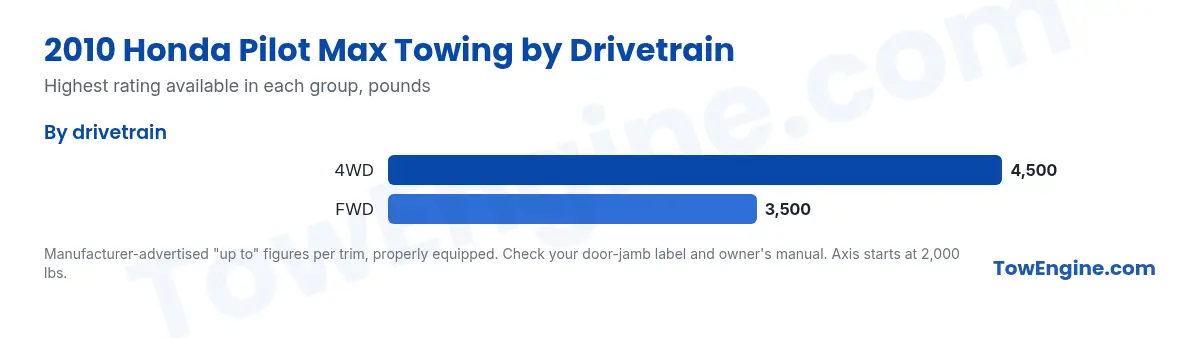
With FWD the same model is rated 3,500 lbs, 1,000 lbs less than with 4WD, usually because the strongest engine or axle ratio comes with 4WD.
Every Trim Compared
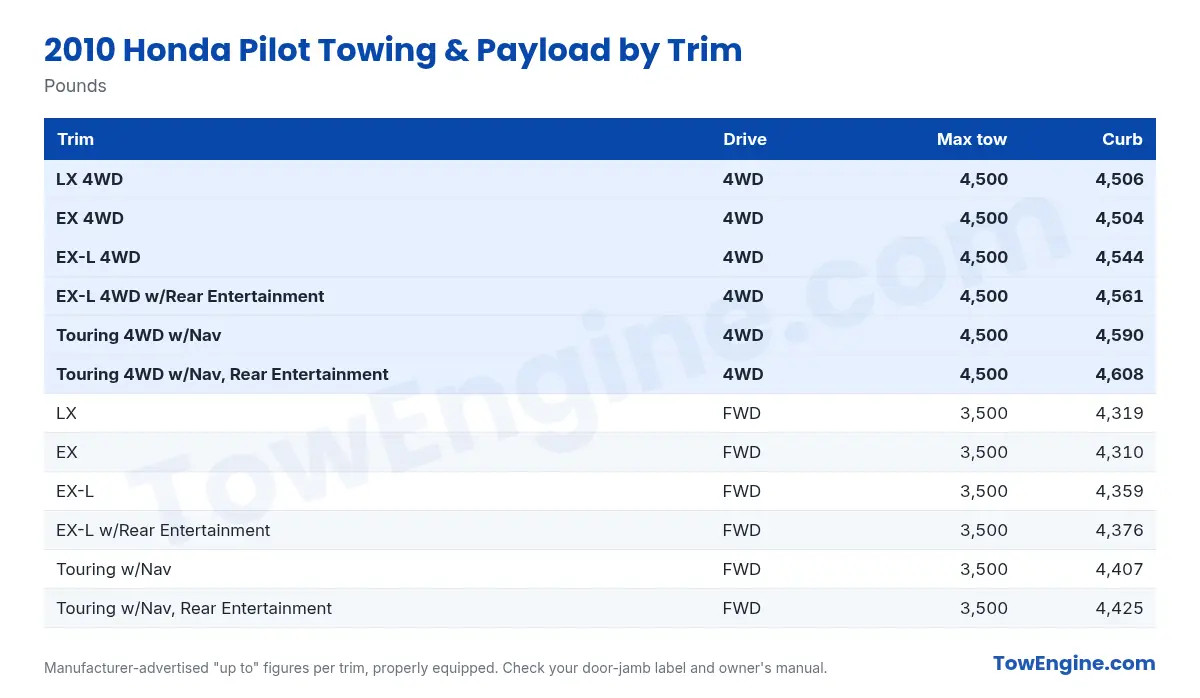
Of the 12 rated trims, the EX-L 4WD tows the most (4,500 lbs) and the LX FWD the least (3,500 lbs). Use the filters to narrow the list by engine, drivetrain or cab.
| Trim | Drive | Engine | Power | Max towing capacity | Curb weight |
|---|---|---|---|---|---|
| LX 4WD | 4WD | 3.5L V6 | 250 hp | 4,500 | 4,506 |
| EX 4WD | 4WD | 3.5L V6 | 250 hp | 4,500 | 4,504 |
| EX-L 4WD | 4WD | 3.5L V6 | 250 hp | 4,500 | 4,544 |
| EX-L 4WD w/Rear Entertainment | 4WD | 3.5L V6 | 250 hp | 4,500 | 4,561 |
| Touring 4WD w/Nav | 4WD | 3.5L V6 | 250 hp | 4,500 | 4,590 |
| Touring 4WD w/Nav, Rear Entertainment | 4WD | 3.5L V6 | 250 hp | 4,500 | 4,608 |
| LX | FWD | 3.5L V6 | 250 hp | 3,500 | 4,319 |
| EX | FWD | 3.5L V6 | 250 hp | 3,500 | 4,310 |
| EX-L | FWD | 3.5L V6 | 250 hp | 3,500 | 4,359 |
| EX-L w/Rear Entertainment | FWD | 3.5L V6 | 250 hp | 3,500 | 4,376 |
| Touring w/Nav | FWD | 3.5L V6 | 250 hp | 3,500 | 4,407 |
| Touring w/Nav, Rear Entertainment | FWD | 3.5L V6 | 250 hp | 3,500 | 4,425 |
All weights in lbs. Each row is the trim's best published rating; "—" means no published figure.
Wheelbase, Fuel and Other Towing Specs
Wheelbase runs 109.2 in, the tank holds 21.0 gallons and EPA highway economy is 22–23 mpg (expect far less with a trailer).
A longer wheelbase is steadier with a trailer behind it; at 109 in, this one sits on the short side, so keep trailers light and balanced. Towing often halves fuel economy, so the 21-gallon tank means more frequent stops.
| Spec | Range across trims |
|---|---|
| Wheelbase | 109.2 in |
| Overall length | 190.9 in |
| Fuel tank | 21.0 gal |
| EPA city | 16–17 mpg |
| EPA highway | 22–23 mpg |
| Seating | 8 seats |
| Ground clearance | 8.0 in |
| Overall height | 71.0–72.7 in |
| Body width (no mirrors) | 78.5 in |
| Turning circle | 37.7 ft |
Off-Road Angles and Clearance
Approach angle 27.8° and departure angle 24.5°. A hitch, ball mount or loaded trailer cuts the departure angle, so take steep ramps and driveway lips at an angle.
| Angle / depth | Range across trims |
|---|---|
| Approach angle | 27.8° |
| Departure angle | 24.5° |
Engine and Chassis Specifications
Engine Specifications
The 3.5L V6 (engine code J35Z4) is naturally aspirated, with port injection, a compression ratio of 10.5:1 and 89.0 × 93.0 mm bore and stroke. Plan on roughly 4.5 quarts of oil (5W-20 grade) at each change. Regular trailer towing counts as severe service in most owner's manuals, which usually means shorter oil-change intervals.
| Spec | 3.5L V6 |
|---|---|
| Engine code | J35Z4 |
| Layout | V6, naturally aspirated |
| Displacement | 3,471 cc |
| Bore × stroke | 89.0 × 93.0 mm |
| Compression ratio | 10.5:1 |
| Fuel system | Port injection |
| Valvetrain | SOHC, variable valve timing |
| Engine oil capacity | 4.5 qt |
| Oil viscosity | 5W-20 |
| Coolant capacity | 7.9 qt |
Chassis, Suspension, Brakes and Tires
The front suspension is macPherson struts and the rear is multi-link. Brakes are vented discs (13.0 in) in front and discs (13.1 in) at the rear. The factory tire size is 245/65R17. Tire pressure matters more with a trailer; use the full-load figures from the door placard.
| Component | Details |
|---|---|
| Front suspension | MacPherson struts |
| Rear suspension | Multi-link |
| Front brakes | Vented discs (13.0 in) |
| Rear brakes | Discs (13.1 in) |
| Steering | Rack and pinion |
| Factory tire sizes | 245/65R17 |
| Wheel sizes (diameter × width) | 17 x 7.5 in |
Choosing the Right Hitch
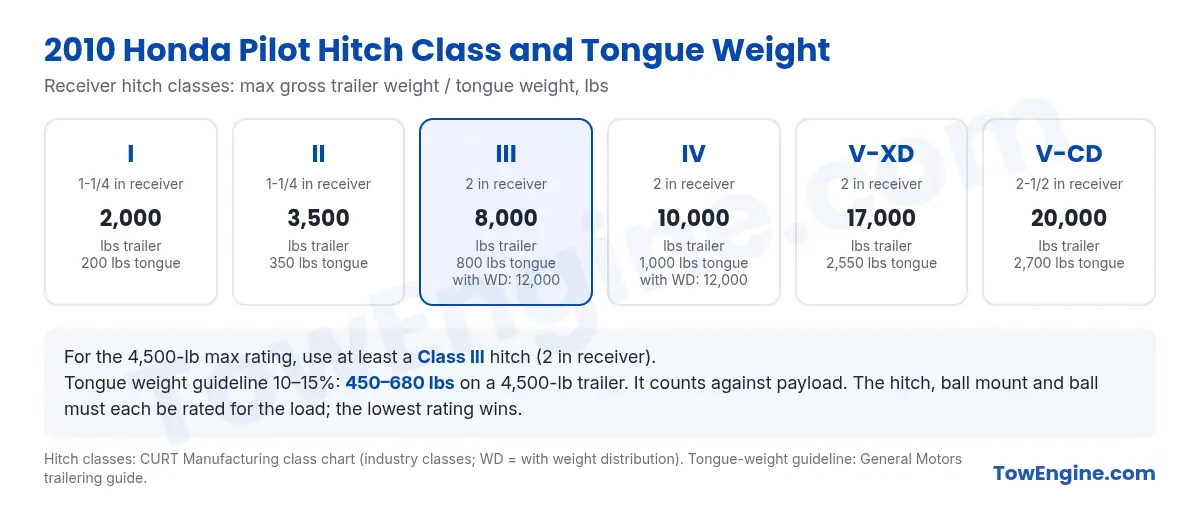
Match hitch class to the load: the 2010 Honda Pilot uses a Class 3 with a 2-inch receiver for its 4,500-lb rating.
| Hitch class | Receiver | Max trailer weight | Max tongue weight |
|---|---|---|---|
| Class 2 | 1-1/4-inch | 3,500 lbs | 350 lbs |
| Class 3 | 2-inch | 8,000 lbs | 800 lbs |
| Class 4 | 2-inch | 10,000 lbs | 1,000 lbs |
| Class 5 Xtra Duty | 2-inch | 17,000 lbs | 2,550 lbs |
| Class 5 Commercial Duty | 2-1/2-inch | 20,000 lbs | 2,700 lbs |
Expect the tongue to press down with 10–15% of the trailer's weight, about 450–680 lbs for a 4,500-lb trailer, and that load comes out of payload.
Compare Class 3 hitches & ball mounts
What It Can Tow
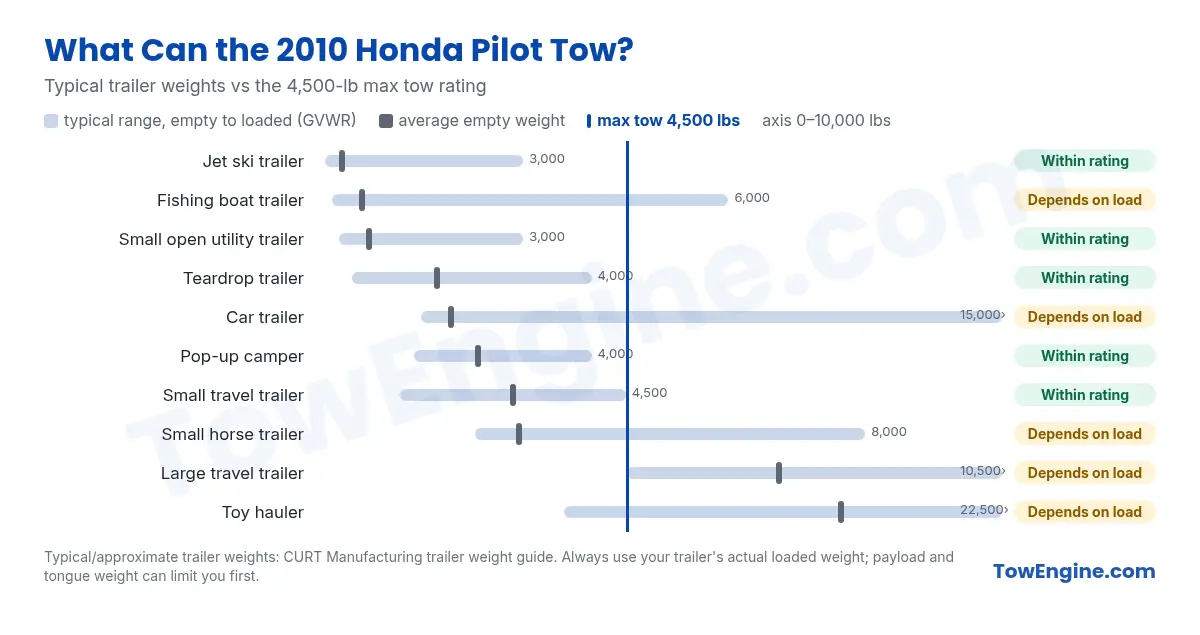
Its 4,500-lb rating covers trailers as heavy as small travel trailers and teardrop trailers. Fishing boat trailers, car trailers, small horse trailers and 2 more depend on the actual loaded weight.
| Trailer | Typical loaded weight | Vs max towing capacity |
|---|---|---|
| Jet ski trailer | 800–3,000 lbs | Within rating |
| Fishing boat trailer | 900–6,000 lbs | Depends on the trailer |
| Small open utility trailer | 1,000–3,000 lbs | Within rating |
| Teardrop trailer | 2,000–4,000 lbs | Within rating |
| Car trailer | 6,000–15,000 lbs | Depends on the trailer |
| Pop-up camper | 2,700–4,000 lbs | Within rating |
| Small travel trailer | 1,900–4,500 lbs | Within rating |
| Small horse trailer | 7,000–8,000 lbs | Depends on the trailer |
| Large travel trailer | 6,300–10,500 lbs | Depends on the trailer |
| Toy hauler | 14,700–22,500 lbs | Depends on the trailer |
Approximate loaded weights; weigh your own trailer. With published of payload, tongue weight and cargo can limit you before the tow rating does.
Brake controllers, locks & more for up to 4,500 lbs
Changes From 2009
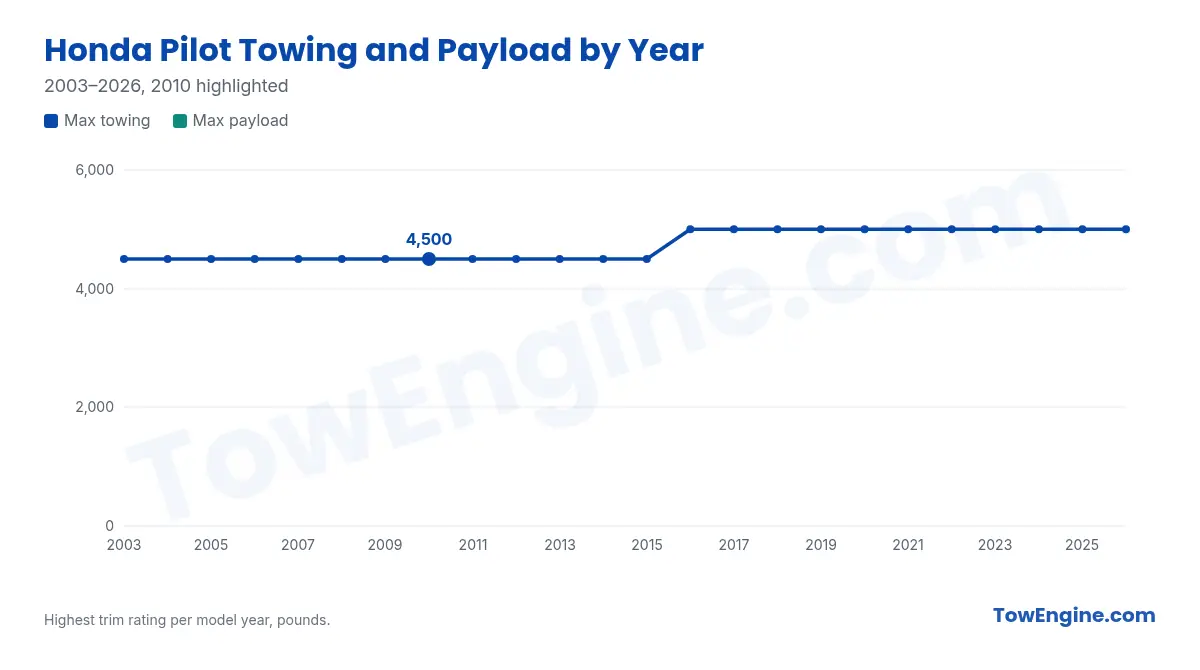
Maximum towing is unchanged from 2009 at 4,500 lbs. See the 2009 Honda Pilot ratings.
Towing Capacity by Model Year
Nearby model years at a glance; the chart below spans 2003–2026:
| Model year | Max towing capacity | Max payload capacity |
|---|---|---|
| 2006, 2007, 2008, 2009 | 4,500 lbs | — |
| 2010 | 4,500 lbs | — |
| 2011, 2012, 2013, 2014 | 4,500 lbs | — |
Towing and Payload Charts
Best Towing Gear for the Pilot
As an Amazon Associate I earn from qualifying purchases.
To tow up to 4,500 lbs safely, plan on a Class 3 receiver hitch, a brake controller, hitch and coupler locks and a tongue weight scale.
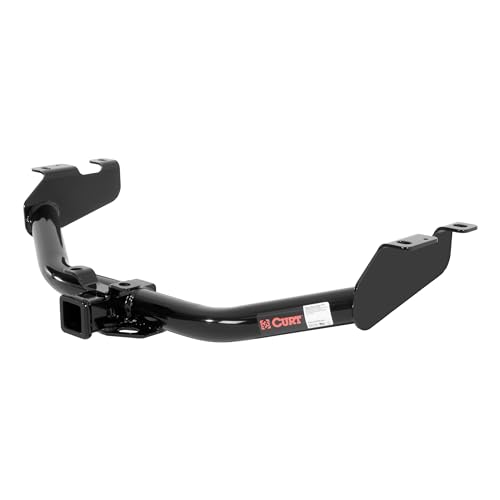
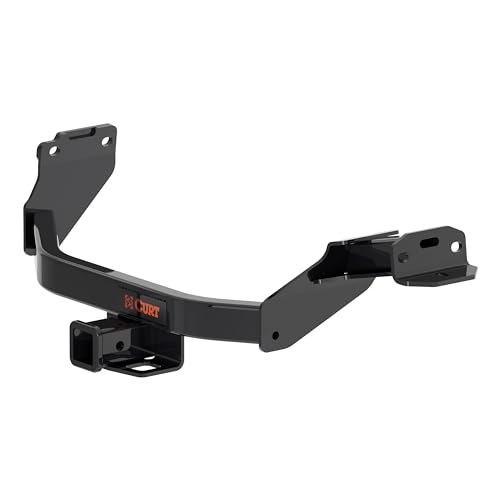
Class 3 Receiver Hitch
A bolt-on Class 3 hitch with a 2 inch receiver is the minimum here; its label must cover 4,500 lbs and a 680-lb tongue load.

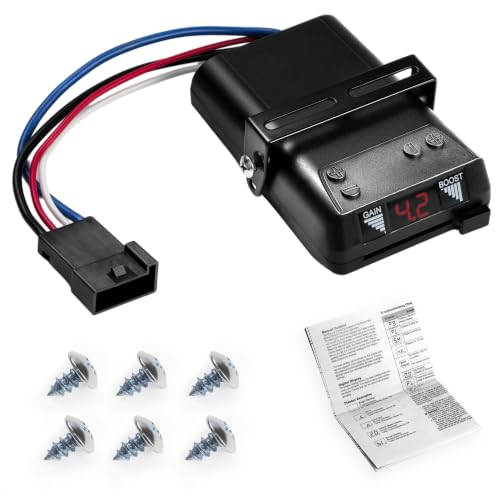
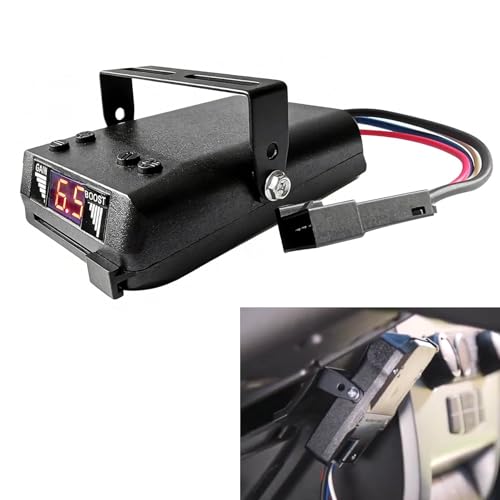
Trailer Brake Controller
A 4,500-lb trailer needs its own brakes, and a proportional controller (plus a plug-in harness) runs them unless your trim has one built in.

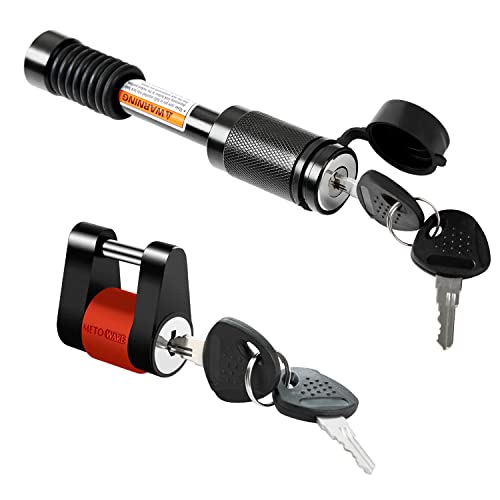
Hitch and Coupler Locks
A coupler lock stops anyone hitching your parked trailer, and a receiver pin lock keeps the ball mount on the truck.


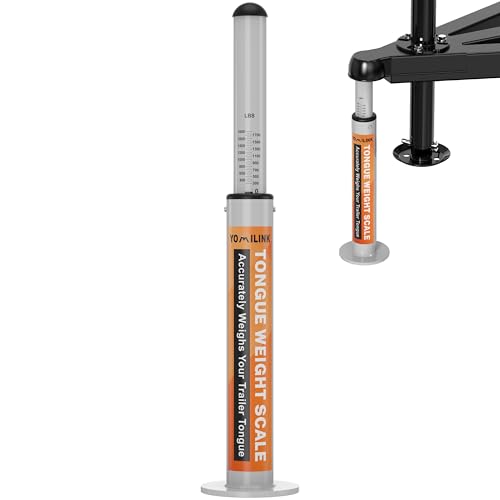
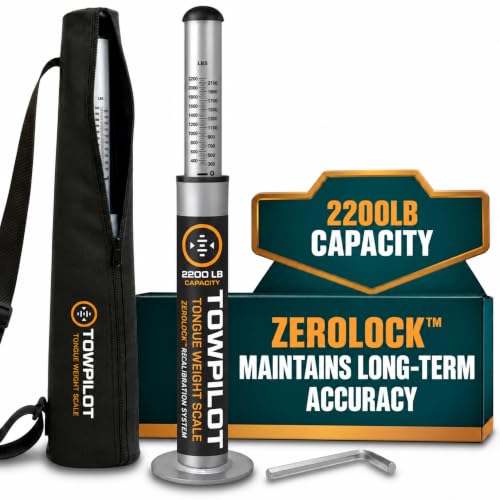
Tongue Weight Scale
Too little tongue weight causes sway and too much overloads the rear axle; a scale confirms the 450–680-lb window.

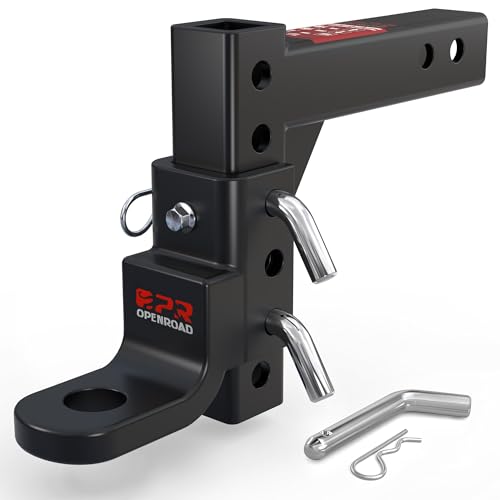
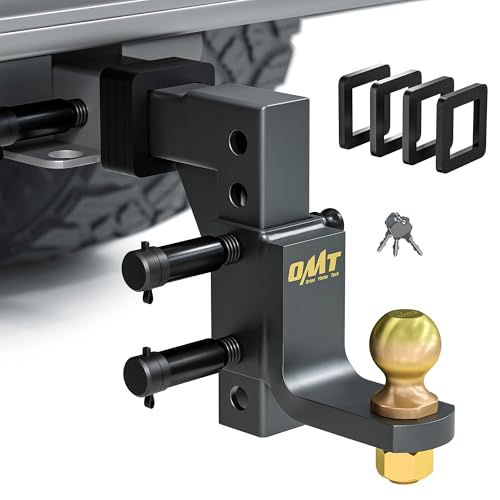
Adjustable Ball Mount
A level trailer tracks better and loads its axles evenly; measure hitch and coupler height, then choose a 2 inch mount rated past 4,500 lbs.

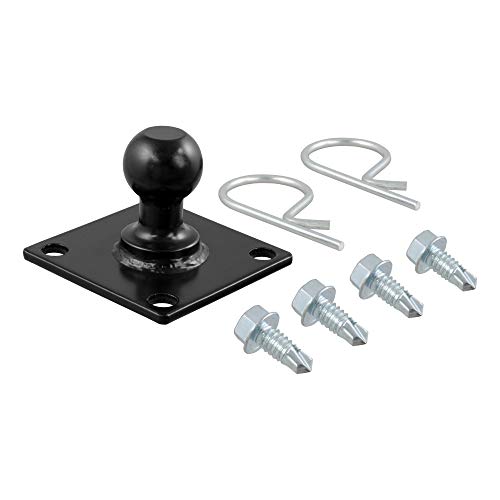
Trailer Sway Control
Add sway control if crosswinds or passing trucks push a trailer of up to 4,500 lbs around.


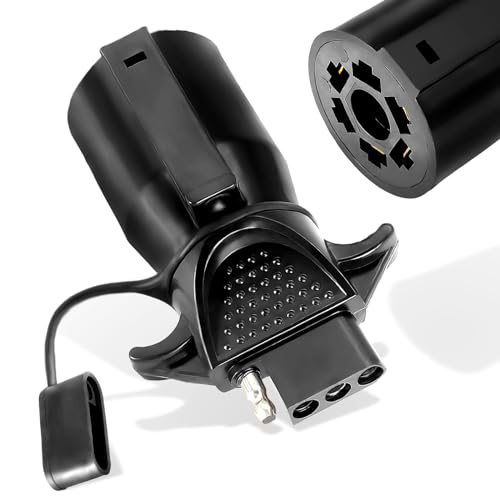
7-Pin to 4-Pin Adapter
Many small utility trailers still use a 4-pin plug; an adapter connects them to the 7-pin socket.


Frequently Asked Questions
How much can the 2010 Honda Pilot tow?
Maximum is 4,500 lbs with the 3.5L V6 on the EX-L 4WD. Ratings start at 3,500 lbs, so check your trim.
What size hitch does the 2010 Honda Pilot need?
Use a Class 3 hitch (2-inch opening, roughly 8,000 lbs GTW) for the 4,500 lbs cap. Figure tongue load near 450–680 lbs against payload.
Can a 2010 Honda Pilot tow a 3,500-pound trailer?
Yes. It can handle 3,500 lbs with the 3.5L V6 on the EX-L 4WD; that leaves roughly 1,000 lbs under the published max of 4,500 lbs.
Does 4WD lower the 2010 Honda Pilot towing capacity?
No. 4WD versions are rated higher here: 4WD up to 4,500 lbs; FWD up to 3,500 lbs.
Can the 2010 Honda Pilot tow more than the 2009 model?
No. Both model years top out at 4,500 lbs.
How We Sourced These Ratings
The numbers on this page are the manufacturer's published per-trim maximums (towing, payload, GVWR, curb weight). Equipment and load change the real limits of a given vehicle, so check its door-jamb label and the owner's manual for that VIN.
- SAE J2807 tow-rating standard
- NHTSA vPIC VIN decoder
- 49 CFR Part 575 (consumer information)
- Hitch classes and typical trailer weights: industry receiver-hitch class charts and typical trailer-weight ranges (approximate).
Data version 2026-10; page updated November 2026.
Explore Capacities by Vehicle Make